
When Dirty Rough Drafts Feel More Alive Than Polished AI Writing


I want your ugly, I want your disease. — Lady Gaga
During my time at EdSurge, I edited and published close to a thousand articles from hundreds of writers. These were entrepreneurs, teachers, researchers, policymakers, investors, and fellow reporters. It is a diverse group of people with different styles and competencies, used to writing for different audiences. My job was to make sure their ideas came across as clear and compelling as possible to lay readers.
Some rough drafts were truly rough: Stream-of-consciousness word vomits, half-baked ideas, meandering narratives, illogical leaps, excessive throat clearing, and beating around the bush before getting to the main point.
As frustrating as some of those salvage jobs were, there is something I’ve come to appreciate about them, now that so much writing arrives AI-polished. A rough draft is a window into how someone thinks, and the jagged edges are where the voice lives, where a piece shows its teeth. While AI can raise the floor on prose, it can also flatten the very quirks that make ideas feel alive.
How people write mirrors how they speak, and think. Teachers have to explain things to children and parents, and sometimes their writing comes off a little repetitive. Founders and investors like to use heuristics and shortcuts, relying on jargon and acronyms. Researchers pack numbers, facts, references, assertions and qualifiers into logically unassailable sentences, sometimes at the expense of clarity.
As I read, I try to hear their voices. I imagine the person speaking. The redundancies, the drawn-out sentences, even the awkward phrasing are clues about what they care about. An idea repeated several times is clearly important. Verbosity is part of the art. These habits carry personality, and are also what AI tends to sand down.
One of the most rewarding “aha” moments as an editor comes when I ask, “So what are you really trying to say here?” Sometimes, what the writer says out loud is the clearest articulation of the idea in print. The written word is ultimately a dialogue between writer and reader, and it often takes dialogue between writer and editor to make that conversation clear. It’s a human moment: arriving at clarity together.
What I see now from AI-assisted first drafts misses some of these moments. Everything is compressed into passable writing. It seems to make sense (or does it?) Gone are the small grammatical errors and long-winded sentences. There’s a general flow, and it moves along.
But sometimes, they lack soul. They are perfectly average and anodyne.
AI drafts often iron out these quirks before I ever see them. The writing looks finished, but I find myself wondering whether the thinking underneath is as well. AI writing sounds confident, so it can make the writer sound confident and tempt me to trust that confidence. It’s a slippery slope.
In place of voice, AI often introduces its own telltale conventions that, by now, seem trite and even comical. The excessive hyphenation. Words like “delve.” Lists and sequences consisting of exactly three items. The “X is not just Y, but also Z” construction, as if every idea needs to be dramatically reframed. (“AI is not just a tool, but a transformative force!”) And why does it try to force section headers so much?
Of course, these conventions exist for good reason. It would be overkill to go out of one’s way to avoid them just to avoid sounding like AI. But when adopted wantonly, I wonder whether they impose a logic that is forced upon the writer. (Did you really mean or need to state that AI is not just a tool?)
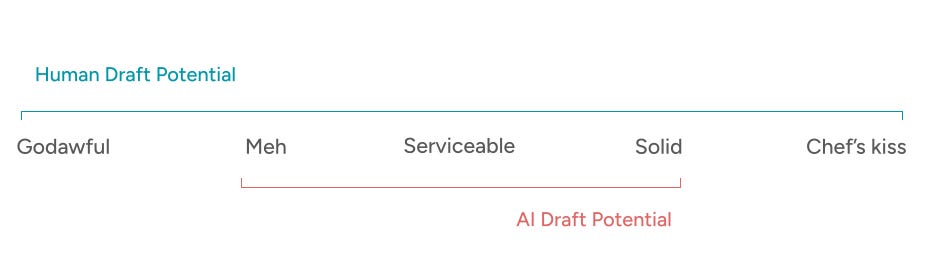
Before generative AI, I felt confident some C- drafts could be turned into A pieces. With it, I see B- work that can be nudged into B+, or even A-. There is real value in raising the floor, particularly for non-native English speakers, or for those without access to an editor or teacher.
But I wonder about what happens to the ceiling: the deviant styles, raw ideas, and voices that don’t quite fit a template. Somewhere in the mess are kernels of potential and personality, and evidence of thinking and struggle. All of which is still richer than something that merely sounds polished.
Lovely post Tony. You had me at the Gaga quote. Hat-tip to Jen Carolan for sharing on Linkedin.
we've started to see this movement if so many ways; the surge of film cameras being sold, the increased popularity of record players, instagram posts being less poised... culture always has a way of snapping back.